
What first motivated you to apply for Chartered Scientist status?
My core purpose as a microbiological risk assessor is to support credible, timely decisions that protect people and organisations by evaluating evidence transparently and acknowledging uncertainty. After several years working across the food system—at a competent authority, in retail, in a large manufacturing environment, and in academia—I wanted a professional standard that recognised not only technical expertise but the application of that expertise under pressure. I applied for CSci while on EFSA’s EU‑FORA programme, deliberately prioritising learning and breadth of perspective over job security at that time. The CSci framework aligned closely with how I already operated (sound judgement under uncertainty, responsible practice, clear communication, continuous development), so it felt like an authentic validation rather than a credential to pursue for its own sake. Later, being nominated in 2025 for the Science Council’s CSci Award affirmed that peers value this approach—particularly the emphasis on integrity, reflection, and mentoring across sectors.
Was there a specific moment or challenge that made you think: “I’m ready for this”?
There wasn’t a single headline moment, but a consistent pattern in incident response work. I repeatedly led assessments where information was incomplete, timelines were tight, and consequences for consumers and businesses were significant. The task was to exercise the best possible judgement under uncertainty, make assumptions explicit, draw on external expertise where appropriate, and present conclusions in a form that decision‑makers could use. Independent validation of this approach—such as acknowledgement from expert advisers to the regulator and recognition for clear, evidence‑based outputs in sensitive cases—showed that the behaviours expected of a Chartered Scientist were already embedded in my practice. That’s when I concluded, “I’m operating at this standard; I should formalise it.” The CSci competencies then offered a structured way to document what I did, how I did it, and why—sharpening my own thinking as much as creating an external record.
Has the process made you reflect differently on your professional practice?
Yes—profoundly. The competence report prompted me to articulate tacit habits: how I calibrate uncertainty, when I draw on external input, and how I shape outputs to real decision needs. It also captured specific improvements I had introduced, such as aligning certain incident outputs with existing policy frameworks so risk‑management decisions could be reached more quickly without compromising rigour. Since completing CSci, I’ve used the same structure to mentor colleagues—deconstructing good practice into teachable steps and templates, and standardising language so teams communicate consistently under pressure. The reflection also highlighted how cross‑sector experience (regulator, retail, manufacturer, EFSA EU‑FORA fellowship) strengthens judgement; it helps anticipate what different stakeholders require from a risk characterisation and prevents drift into risk management, which could compromise key risk‑assessment principles of independence and scientific integrity. In short, CSci didn’t change my core approach; it made it clearer, more repeatable, and easier to teach, with tangible benefits for the quality and speed of incident response.
Why did you choose to pursue Chartered Scientist through IFST?
While microbiological risk assessment is relevant to other domains, many of which I have explored professionally, the food system, which is intertwined with IFST, remains its primary context. I wanted my chartered assessment to evaluate not only my depth of microbiology but also whether I translate evidence into decision‑ready outputs that ultimately protect consumers and businesses. IFST’s framing does exactly that. It also acknowledges the realities of cross‑disciplinary collaboration and the importance of clear communication to non‑specialists. As an active member who serves on the Membership Assessment Panel, I value IFST’s balanced view of science, industry, and public protection, and its emphasis on professionalism and CPD. Pursuing CSci through IFST therefore felt like the most relevant, practice‑anchored route for my field—one that keeps me accountable to high standards and connected to a community that cares about integrity and the real‑world impact of food safety decisions.
If you had to sum up the value of CSci in one sentence, what would it be?
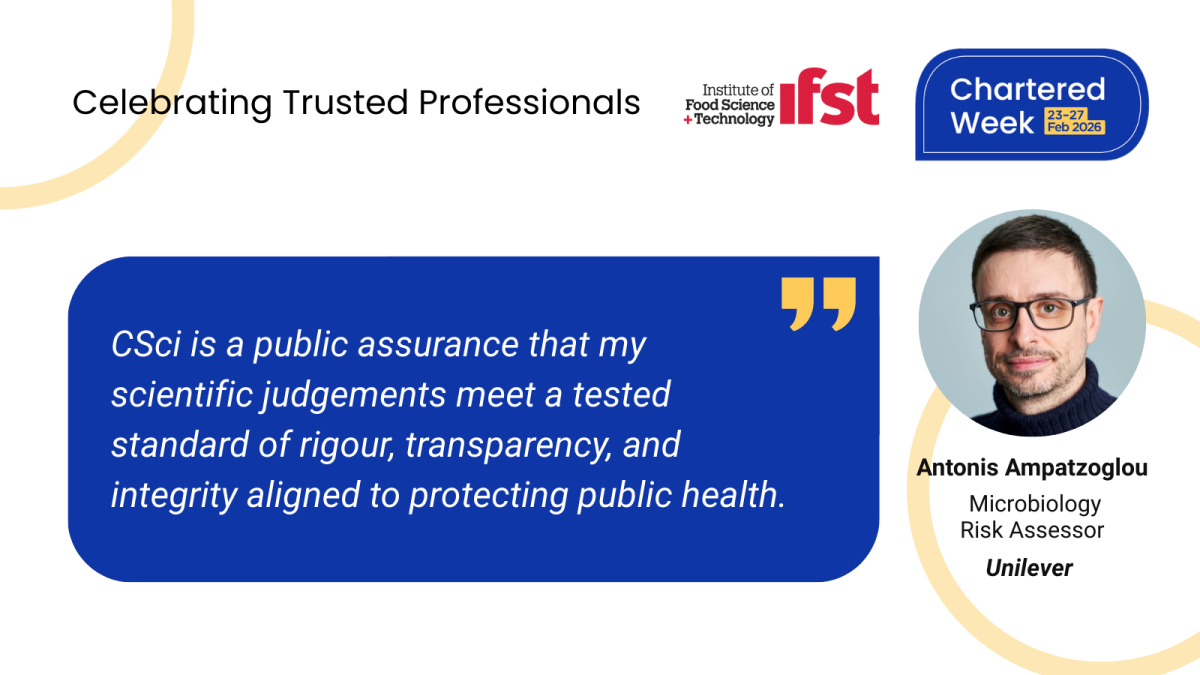
One‑sentence value: CSci is a public assurance that my scientific judgements—formed under time pressure and uncertainty—meet a tested standard of rigour, transparency, and integrity aligned to protecting public health.
- Context: The value goes beyond a post‑nominal. It codifies expectations for how science is practised: evidence first, uncertainty made explicit, ethics central, and communication tailored to real decisions. It also raises the bar on reflection and CPD—which, in incident work, directly influences response speed and quality. Finally, it has cross‑sector relevance; whether supporting a competent authority, a retailer, a manufacturer, or a research setting, the same standards apply. That portability maintains consistency when stakeholder priorities differ and builds trust in the outputs we deliver.
What did being “chartered” mean to you personally before you applied?
Before applying, “chartered” meant trust—that peers had scrutinised not only my knowledge, but how I use it in complex, ambiguous situations. It also meant accountability: committing to a code that prioritises scientific integrity, openness about uncertainty, and continual learning. This resonated with choices I had made in my career, such as joining the EFSA EU‑FORA fellowship and deliberately seeking perspectives across the food system to strengthen judgement. I viewed CSci as a way to formalise that ethos so it was not just a personal standard but a public commitment. Importantly, the CSci structure mirrored how I already worked in incidents—transparent about assumptions, careful with evidence, and focused on decision utility—so it promised both validation and a mechanism for ongoing reflection.
Do you see CSci as important for protecting consumers and public health?
Absolutely. Protection depends on two things: the quality of the underlying science and the clarity with which it is converted into decisions. CSci strengthens both. By requiring rigorous handling of evidence and uncertainty, it improves the robustness of risk assessments that inform proportionate actions in incidents and policy. By emphasising ethics and professional standards, it helps ensure assessments remain independent of non‑scientific pressures. By demanding continual development, it keeps practitioners current with evolving methods and approaches. In short, CSci establishes consistent expectations for scientists whose outputs directly influence consumer protection and public confidence—the very outcomes that incident response is designed to safeguard.
What does being a Chartered Scientist allow you to say about yourself, professionally?
That my practice has been independently assessed against a portable, cross‑sector benchmark, and that I am committed to the ongoing standards it entails. Concretely, it says I can exercise sound, transparent judgement under uncertainty, communicate effectively to non‑specialists, and act with integrity—especially when timelines are tight and stakes are high. It also signals a track record of continuous development and mentoring: I invest in my own growth and help build capability in teams and networks. The fact that I was later nominated (2025) for the Science Council’s CSci Award suggests this approach resonates more widely within the professional community. For anyone relying on my assessments—whether in a competent authority, retail, manufacturing, or research context—CSci provides external assurance about how I work, not just what I know.